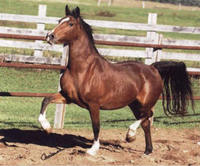
The word "stud" comes from the Old English 'stod' meaning "herd of horses, place where horses are kept for breeding"
Around the world, private individuals have breeding farms of various sizes that are dedicated to animal breeding, usually of purebred livestock. Some of the largest and most impressive are those dedicated to Thoroughbred horse breeding, such as the historic Claiborne Farm in Kentucky, USA or the Darley Stud, owned by Dubai H.H. Sheikh Mohammed bin Rashid Al Maktoum, which stands over fifty stallions at stud in facilities located in seven countries.
Many stud farms make male animals available for breeding to outside female animals that are not owned by the stud farm. Doing so provides an outside source of revenue to a stud farm via the stud fees paid to obtain the services of the stud animal as well as contributing to the overall genetic diversity of the animal's offspring. At state stud farms, stud service is not only a source of income, but due to the high standards set for breeding animals, has an overall effect of improving the quality of animals throughout an area.
In most cases, the owner of the female brings the animal to the stud farm for breeding, sometimes leaving her there for over a month to be sure that pregnancy has occurred. However, with the invention of artificial insemination and the ability to ship semen, combined with the availability of DNA testing for parentage verification, many breed registries allow semen to be shipped from the stud farm to the location of the female animal, thus reducing or eliminating the need for animals to travel.
For more information on Stud Farms in the U.K., and for a list of potential farms in your area, click HERE.
If you live in or around the Crieff, Perthshire area, make sure that you check outCrieff Hydro Hotel's very own Riding Centre, set within 900 acres of beautiful Perthshire countryside at the foot of the Knock of Crieff, the Crieff Hydro Riding Centre boasts a unique setting for horsey lovers. Check out the official Hydro Riding Website for more information- http://hydroriding.com/
Showing posts with label horse breeding. Show all posts
Tuesday, 12 March 2013
Wednesday, 6 March 2013
Horse Passports not effective enough
![]() |
| More work needs to be done to track horses properly says RSPCA |
It has found that three quarters of the horses they take in do not have passports and are not microchipped, which is a legal requirement.
A lack of enforcement means that owners don't keep passports updated.
This makes it much more difficult to track down those responsible if there are concerns about horses' welfare.
RSPCA equine co-ordinator Cathy Hyde, said: "The passport system is failing and a shocking 75 per cent of horses coming into RSPCA care are not microchipped.
"Horses can change hands for a small amount of money and end up in the hands of irresponsible owners and traders."
They are calling on the Government to take the issue more seriously.
Sunday, 17 February 2013
Different Horse Breeds From Around the World
Like their owners, Horses come in different shapes and sizes! You horse will always be unique to you, but there are so many factors that influence the look, shape, size and behaviour of horses resulting in dozens of different breeds each with their own defining characteristics.
First off, here's a bit of history.
Horses were one of the first animals that were domesticated by man for meat and milk. History records tell us that horses were first tamed by the people of the steppes region of central Asia around 3000 BC to 4000 BC.
There are even cave paintings made by Stone Age man that depict images of animals with strong, erect heads with manes that are similar to the modern horse. There are a variety of different horse breeds that are diverse with respect to appearance, nature and toughness.
Here is a selection of some exotic horse breeds from all around the world:
Akhal Teke: is one of the ancient horse breeds. Its presence dates back to about 500 BC. Also known as Turkoman, Akhal Teke horse has a self willed nature and the rider can hardly do anything if it changes its mood. Despite its bad temper, the horse has a majestic appearance with narrow chest and slender in appearance. Has been prized possession for central Asiatic nomadic tribes because the horse being very hardy which can travel for long distances by crossing deserts without a drop of water. The horse is a long jumper and is often seen to be taking part in sports.
Anglo Arabic: The horse is the result of years of interbreeding. The horse is native to Britain, France and Poland. It is by nature brave and joyous. It has a long neck often forming an arch. The head of the horse is delicate with large highly expressive eyes. Have a broad shoulder and neck but with a short back. The bones of the horse are generally of good quality and the legs are long and slender in form. These horses are commonly used for sports, eventing and for hunting.
Cleveland Bay: This breed of horse is native to England. The horse is generally of brown in colour. Do not purchase this breed of horse with white marks. You may purchase the horse if it has some traces of white hair or white specks near the legs. The horse is extremely hardy. The entire body structure has convex like appearance and has a large head. This breed of horse is characterized by kind appearing eyes and is highly intelligent. This horse is nick named as Chapman horse as during the 16th and the 17th centuries the horse was used as the mode of transport for travelling long distances by the Chapmen or the merchants.
Hackney: This breed of horse has its origin in England. It grows up to the size of about 14 hh to 15 hh in height. The horse is genuinely very alert and is also very sweet natured. It has a straight head with strong shoulders. The horse has flexible joints and strong legs and has a flamboyant pace. Each gallop is taken with a second’s rest of the foot in air resulting in a graceful movement.
Caspian: This breed of horse is an exotic one which a few decades back were through to be extinct. The variety of horse falls in the miniature breed of the horses. The horse was highly coveted by people of ancient civilization to carry out ritualistic purposes. These horses are native to Persia, Mt Elbrutz region and Caspian Sea. These horses are characterized by bay, brown or chest nut colours. The head has the appearance of the Arabian horses with small ears and prominent eyes. The horse is quite active and has a tendency of jumping while galloping.
First off, here's a bit of history.
Horses were one of the first animals that were domesticated by man for meat and milk. History records tell us that horses were first tamed by the people of the steppes region of central Asia around 3000 BC to 4000 BC.
There are even cave paintings made by Stone Age man that depict images of animals with strong, erect heads with manes that are similar to the modern horse. There are a variety of different horse breeds that are diverse with respect to appearance, nature and toughness.
Here is a selection of some exotic horse breeds from all around the world:
![]() |
| The shimmering Akhal Teke |
![]() |
| Anglo Arabic |
![]() |
| Cleveland Bay |
![]() |
| Hackney |
![]() |
| The Caspian |
Subscribe to:
Posts (Atom)